
From Calgary Trees to Zoo Habitats: Giving Our Urban Forest a Second Life
What happens to a Calgary tree when its life is over? 
Sometimes, apparently, it becomes a giraffe's lunch.
Or a gorilla's new climbing structure.
Or furniture for a hippo.
And honestly, we love this.
The City of Calgary and the Wilder Institute/Calgary Zoo have found a pretty creative second life for wood from trees that needed to be removed or pruned as part of Calgary's urban forest maintenance.
Instead of all of that material heading directly to compost, suitable leaves, branches, seeds and logs are making their way to the zoo.
And the animals are putting them to very good use.
Use our quick navigation guide below to jump to any point of our blog on How Calgary Trees Are Enriching Zoo Habitats:
From Calgary's Urban Forest to the Zoo
How Much Wood Are We Talking About?
Apparently, Giraffes Like Caragana Too
How Can You Enrich Your Own Habitat?
Create a Winter Habitat With Leaves
Turn Branches Into Mulch
Enrich the Human Habitat Too
Calgary Public Fire Pits
Fall Yard Waste
Calgary's Urban Forest
From Calgary's Urban Forest to the Zoo
The trees involved in the project were dead, dying or required pruning as part of The City's ongoing work to manage public safety and care for Calgary's urban forest.
Normally, it's easy to think of what comes down as waste.
The City and the Wilder Institute/Calgary Zoo saw something else.
Food.
Enrichment.
Climbing structures.
Places to explore.
And, in the case of some of the larger logs, what the zoo rather wonderfully describes as animal "furniture."
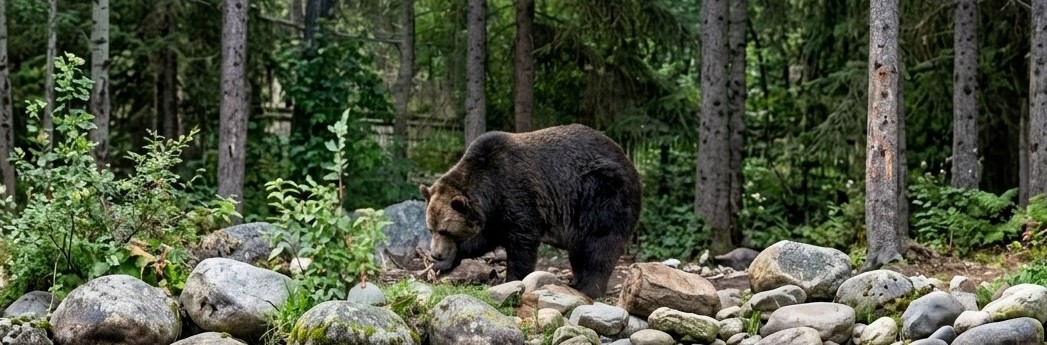
The material is being used by animals including moose, giraffes, camels, gorillas, monkeys and hippos, giving them opportunities to snack, forage, climb, explore and play.
That's a pretty great second act for a Calgary tree.
READ THE CITY OF CALGARY STORY
Just How Much Wood Are We Talking About? .jpg)
Quite a bit.
According to The City, the tree removals produced:
- 304 bags of browse weighing approximately 6–7 kilograms each
- 10 barrels of woody material weighing approximately 16–22 kilograms each
- 1.5 truckloads of bagged branches
- Numerous large logs for use as “furniture” inside animal habitats
Hundreds of zoo volunteers helped make it happen.
They stripped leaves from branches, bagged leaves, seeds and woody material, cut and sorted smaller branches and helped move everything into trucks for transportation.
That's a lot of effort for material that could easily have been looked at as nothing more than the leftovers from removing a tree.
And that's kind of the point.
Apparently, Giraffes Like Caragana Too
Here's another Calgary backyard connection we weren't expecting.
The tree partnership isn't the only material making its way from Calgary Parks to the zoo.
The City says Calgary Parks is also working with the zoo to provide removed invasive caragana plants as a snack for its giraffes.
If you've ever dealt with an overgrown caragana hedge in Calgary, there is something deeply satisfying about discovering a giraffe may be willing to help with the problem.
Unfortunately, this is not a residential pickup service.
We checked.
Okay, we didn't check.
But please don't call the zoo about your hedge.
A Tree Can Still Have Value After Its Life Ends
There's a bigger idea behind the partnership that we really like.
Calgary spends a lot of time and resources growing and maintaining its urban forest.
Eventually, some of those trees reach the end of their lives.
Others become damaged, decline or need to be removed because they present a safety risk.
But removal doesn't necessarily have to be the end of the story.
As Calgary's Urban Forestry Superintendent Wayne Driscoll put it, the partnership demonstrates how value can continue to be created even after a tree's lifecycle has ended.
Here, that means reducing waste while simultaneously creating something useful for animal care.
And it got us thinking about our own backyards.
So... How Can You Enrich Your Own Habitat?
No hippos? .jpg)
No giraffes?
That's okay.
Your backyard is still a habitat.
For you, obviously.
But also for birds, bees, butterflies and all sorts of smaller Calgary residents who have absolutely no intention of contributing to the mortgage.
And fall is when many of us start removing everything from that habitat.
Leaves get bagged.
Plants get chopped down.
Branches disappear.
The yard gets progressively cleaner until there's almost nothing left but grass and snow.
Maybe the zoo's approach is a good reminder to look at some of that material differently.
Create a Winter Habitat With Leaves
You don't have to keep every leaf exactly where it lands.
But you also don't have to remove every single one.
Leaves from the lawn can be moved into garden beds and underneath shrubs, where they can provide shelter for insects and pollinators over winter while eventually returning organic material to the soil.
The City specifically recommends leaving some leaves and natural material behind to support overwintering pollinators.
Basically, your garden bed can become the insect version of the zoo's luxury winter accommodations.
The amenities are admittedly limited.
CREATE WINTER HABITAT FOR CALGARY POLLINATORS
Leave a Little Furniture Behind
If large Calgary logs can become furniture for zoo animals, a suitable piece of natural wood can also become part of a backyard landscape.
A log can be incorporated into a naturalized garden.
Smaller woody material can provide habitat.
Suitable untreated branches can potentially be chipped and reused as mulch.
And you might want to leave some perennial stems standing until spring because some native bees overwinter inside plant stems.
The goal isn't to turn the backyard into a pile of debris.
It's to stop assuming that "clean" automatically means removing every natural thing from it.
Turn Branches Into Mulch
Branches that are suitable for chipping can potentially have another life right where the tree grew.
Wood-chip mulch can help retain moisture, moderate soil conditions and reduce weeds around trees and garden beds.
Just keep it pulled back from the trunk of the tree rather than creating the infamous mulch volcano.
Don't have branches to chip?
The City of Calgary also makes wood-chip mulch available free to residential customers.
So some of Calgary's tree material can end up helping another generation of Calgary trees.
GET FREE CITY OF CALGARY MULCH
Enrich the Human Habitat Too .jpg)
We shouldn't forget the biggest backyard animals of all.
Us.
Fall is arguably one of the best times to actually use a Calgary backyard.
The mosquitoes are finally losing the battle.
The evenings are cool.
The leaves are changing.
And a fire suddenly sounds much better than it did when it was 30 degrees outside.
If your habitat includes a backyard fire pit, just remember that the pile of freshly cut branches isn't firewood.
Calgary permits clean, dry firewood in backyard fire pits, while yard waste and wet or freshly cut wood aren't permitted burning materials.
We've put together a full Calgary backyard fire guide covering placement, permitted materials, fire bans and other rules.
OUR CALGARY BACKYARD FIRE GUIDE
Borrow Someone Else's Habitat for the Evening
No fire pit at home?
Calgary has you covered.
The City has outdoor fire pits in participating Calgary parks that residents can book for free.
Current reservation periods are two hours, with booking windows from 12–2 p.m., 4–6 p.m. and 7–9 p.m.
Bring your own appropriate firewood.
Don't forage around the park for branches, twigs and pinecones to burn — collecting park material for your fire isn't permitted.
Bring the marshmallows instead.
BOOK A CITY OF CALGARY FIRE PIT
And If You Really Don't Want It...
Not every branch needs an elaborate second career.
Sometimes a branch is just a branch and you want it gone.
Calgary's Green Cart program accepts residential yard waste, including leaves and branches that meet collection requirements.
And from September 18 through October 31, 2026, Calgary residential households can take excess or oversized yard waste to City Eco Centres for free.
That includes leaves, branches, grass clippings and plants with the soil removed.
So reuse what makes sense.
Leave what benefits the garden.
And responsibly compost the rest.
CALGARY FALL YARD WASTE DROP-OFF
Calgary's Urban Forest Is Part of Our Habitat Too 
There's one final piece of this story that's easy to overlook.
Those zoo branches started as part of Calgary's urban forest.
The trees lining our streets, growing in parks and filling private yards do more than look good.
They provide shade, habitat and character, and they're a big part of what makes many Calgary neighbourhoods feel the way they do.
The City measured Calgary's tree canopy at 9.62% in 2024 and has a long-term goal of increasing it to 16%.
We've gone much deeper into Calgary's trees, including our urban canopy, choosing trees for Calgary's climate and caring for the mature trees already growing on your property.
READ OUR CALGARY HOMEOWNER'S GUIDE TO TREES
A Pretty Good Second Act
There's something pretty Calgary about this whole story.
A tree grows in our city for years.
Eventually, its lifecycle ends or it needs to be removed.
Instead of immediately becoming waste, volunteers help process it.
Leaves become food.
Branches become browse.
Logs become furniture.
And somewhere at the Wilder Institute/Calgary Zoo, a giraffe gets lunch and a gorilla gets something new to climb on.
That's a much better ending than "it went in the compost."
And maybe there's a small lesson in there for the rest of us.
The next time you're cleaning up your own little Calgary habitat, take another look before you throw everything away.
You probably don't have a hippo that needs a new coffee table.
But you might have a tree that could use some mulch, a pollinator that could use somewhere to spend the winter or a backyard that doesn't need to be quite as "clean" as you thought.

Calgary Homes Are More Than What's Inside the Front Door
I'm Dusko Sremac, REALTOR® and Team Lead at Real Estate Partners. One of the things we love about Calgary real estate is that the story of a home doesn't stop at the front door. Our trees, yards, parks, wildlife and outdoor spaces are all part of what makes a neighbourhood feel like home.
That's also why stories like Calgary's trees getting a second life at the zoo catch our attention. From caring for the mature trees already growing on our properties to creating space for pollinators and enjoying a backyard fire on a cool fall evening, there are plenty of ways to get more out of our own little Calgary habitats.
We share Calgary homeowner resources like these alongside our real estate information because knowing where you live is about a lot more than knowing what your house is worth.
CONNECT WITH DUSKO BOOK A VIDEO CHATEnjoy this blog post? Click here to subscribe for updates
Leave A Comment