
Kitchen and Cooking Fire Safety in Calgary
The kitchen is where people gather, meals get made and everyday life happens.
It is also one of the most common places for a residential fire to begin.
Most kitchen fires are not caused by some dramatic equipment failure. They start with ordinary decisions: oil left heating, a towel beside the stove, grease that has not been cleaned or someone stepping away for what was supposed to be thirty seconds.
The good news is that most of these risks are easy to reduce.
Stay close to what you are cooking. Keep the area clear. Maintain your appliances. Most importantly, know what to do before a small fire gives you no time to figure it out.
Use Our Quick Navigation Guide Below To Jump To Any Part On Kitchen and Cooking Fire Safety in Calgary: 
- Stay With What You Are Cooking
- Your Stovetop Is Not Extra Counter Space
- Keep a Lid and Dry Oven Mitt Nearby
- Cooking With Oil Requires Your Full Attention
- Never Put Water on Burning Oil
- Know When to Leave
- If a Fire Starts Inside the Oven
- If a Microwave Catches Fire
- Do Not Overlook Small Appliances
- Use Appliances Certified for Canada
- Keep Children and Pets Out of the Cooking Zone
- Do Not Disable the Smoke Alarm
- What Buyers Should Notice in a Kitchen
- What Sellers Should Address Before Listing
- If the Fire Spreads, Get Out
- Pay Attention to What You Heat
Stay With What You Are Cooking
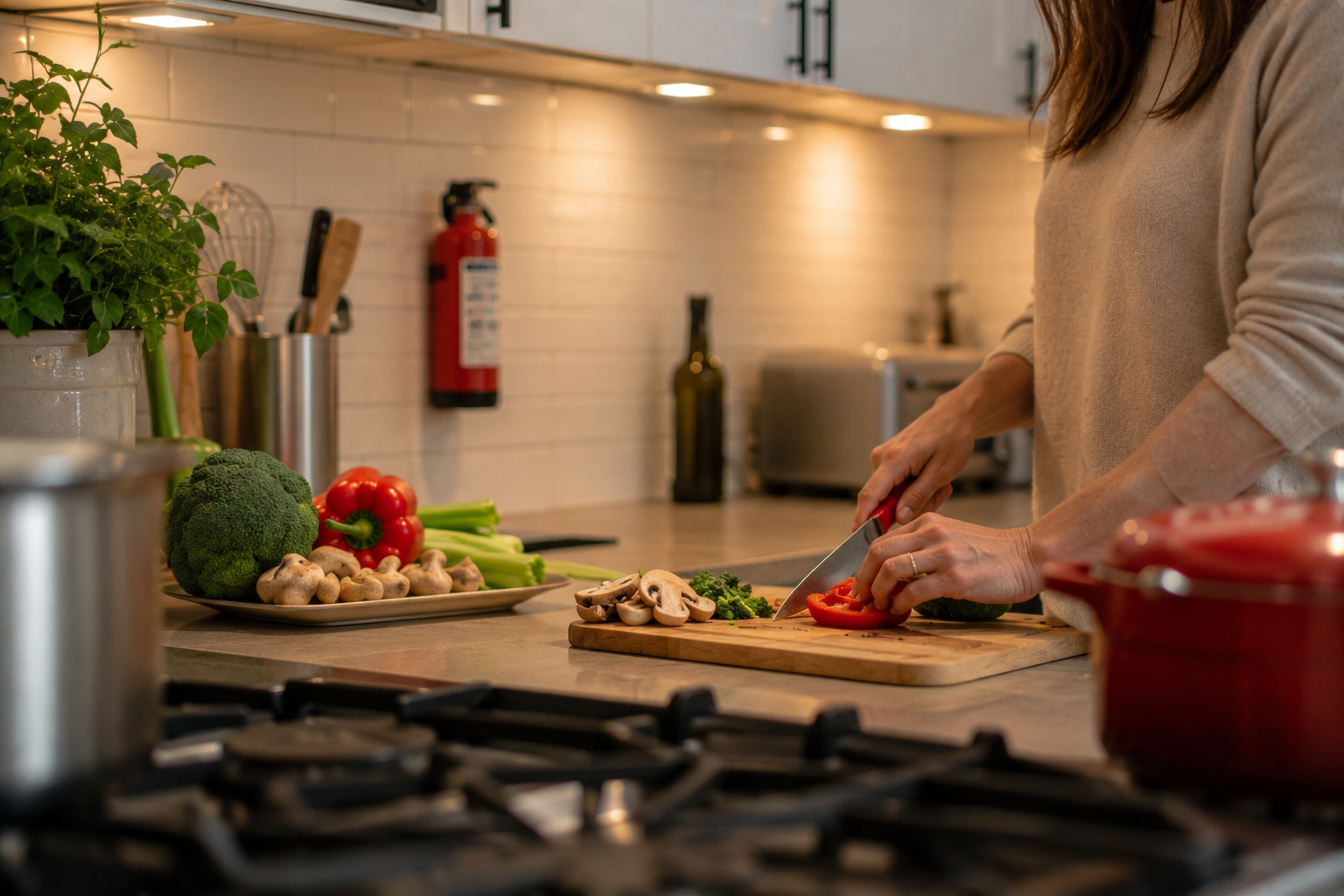
If you are frying, grilling, broiling or boiling food, stay in the kitchen.
If you need to leave—even briefly—turn off the burner and move the pot or pan away from the heat.
Food cooking inside an oven may not require you to stand beside it, but it still needs to be checked regularly. Set a timer and remain inside the home.
A timer can remind you that dinner is cooking. It cannot turn off an overheating pan or put out a fire.
Before using the stove, be honest about whether you are alert enough to cook safely. Fatigue, alcohol, cannabis and certain medications can affect judgment and reaction time.
If there is a reasonable chance you will fall asleep or forget about the burner, choose another way to make the meal. There is no culinary masterpiece worth burning down the kitchen over.
Calgary Cooking Safety Information
Your Stovetop Is Not Extra Counter Space .jpg)
It is easy for a busy kitchen to collect mail, packaging, towels, grocery bags and whatever else needs a temporary home.
The stovetop should never be that home.
Keep anything that can burn away from burners and hot appliances, including:
- Dish towels and oven mitts
- Paper towel
- Wooden utensils
- Food packaging
- Grocery bags
- Mail and paperwork
- Cooking oil and aerosol cans
- Curtains and decorations
- Loose clothing
Use the back burners whenever practical and turn pot handles inward. This reduces the chance of someone bumping the pan, catching it on their clothing or pulling it down.
Keep the stovetop, oven and range hood clean. Built-up grease and food residue can ignite and help a fire spread.
Do not store combustible materials inside the oven or warming drawer. Sooner or later, someone will turn it on without checking.
Keep a Lid and Dry Oven Mitt Nearby
Whenever you cook with oil, keep a properly fitting metal lid and dry oven mitt within reach.
Not across the kitchen. Not somewhere behind the slow cooker. Close enough to use immediately.
A wet oven mitt can transfer heat quickly and cause a steam burn. Make sure the mitt is dry and in good condition.
Cooking With Oil Requires Your Full Attention
Hot oil can ignite quickly and with little warning.
Heat oil gradually, use appropriate cookware and never leave it unattended. If it begins to smoke, it is already too hot. Turn off the burner and allow it to cool.
Be careful when adding wet or frozen food. Moisture can cause hot oil to splatter or overflow onto the burner.
A temperature-controlled deep fryer or electric skillet can provide better control than a large pot of oil on the stove. Follow the manufacturer’s instructions and never exceed the recommended fill level.
Know Before You Cook
If a Small Grease Fire Starts
- Do not move the pan.
- Turn off the burner if you can reach it safely.
- Put on a dry oven mitt.
- Carefully slide a properly fitting metal lid over the pan.
- Turn off the exhaust fan.
- Leave the lid in place until the pan has completely cooled.
Never use water. Never carry the pan outside. Never throw flour, sugar or another cooking ingredient onto the flames.
Never Put Water on Burning Oil
Water does not put out a grease fire. It can spread it across the kitchen.
When water reaches extremely hot oil, it rapidly turns into steam. That sudden expansion can throw burning oil out of the pan and onto nearby cabinets, walls and people.
Do not carry a burning pan to the sink or try to take it outside. One wrong step can spill burning oil across the floor or onto you.
If the flames cannot be smothered immediately and safely, leave the home, close the door behind you and call 9-1-1 from outside.
Know When to Leave
A portable fire extinguisher can help with certain small fires, but it is not a reason to stay inside while the fire grows.
Only consider using one when:
- Everyone else is leaving the home
- Someone has called 9-1-1
- The fire is small and contained
- Smoke is not filling the room
- You have the correct extinguisher
- You know how to use it
- The exit remains directly behind you
Do not discharge an ordinary extinguisher directly into a pan of burning oil at close range. The force can spread the oil and flames.
If the fire has reached the cabinets, spread beyond the original appliance or produced heavy smoke, the decision has already been made. Get out.
Cabinets, appliances and countertops can all be replaced. You cannot.
Calgary Fire Extinguisher Information
If a Fire Starts Inside the Oven
Turn off the heat and keep the oven door closed.
Opening the door gives the fire more oxygen and can allow flames and heat to enter the kitchen.
Do not reach inside or attempt to remove burning food. If the fire does not go out, smoke continues to increase or flames spread beyond the oven, leave and call 9-1-1.
Have the oven inspected before using it again. A fire can damage wiring, controls and insulation even when the outside of the appliance looks fine.
If a Microwave Catches Fire
Keep the microwave door closed. Turn it off and unplug it only if the plug can be reached safely.
Do not open the door to see what is happening. Keeping it closed can help limit the oxygen reaching the fire.
Leave the home and call 9-1-1 if smoke or flames continue.
Before using the microwave again, have it inspected or replace it. The fact that it stopped burning does not mean it is safe to make popcorn in five minutes later.
To reduce microwave risks:
- Plug it directly into a suitable wall outlet
- Do not use an extension cord
- Use microwave-safe containers
- Do not place metal inside unless permitted by the manufacturer
- Clean grease and food residue from the interior
- Stop using it if the cord, door, plug or seal is damaged
Do Not Overlook Small Appliances
Kitchen fires do not only begin on the stove.
Air fryers, toaster ovens, slow cookers, electric skillets, coffee makers, kettles and hot plates all produce heat.
Place them on stable, heat-resistant surfaces with enough space for ventilation. Keep them away from curtains, paper products and combustible materials.
Inspect cords and plugs regularly. Stop using an appliance if you notice:
- A cracked or frayed cord
- A loose or discoloured plug
- Sparking
- A burning smell
- Unusual heat around the outlet
- Melting or scorch marks
- A breaker that repeatedly trips
Heat-producing appliances should generally be plugged directly into suitable wall outlets. Do not use a power bar to turn one kitchen outlet into a small electrical subdivision.
Clean toaster crumb trays and remove grease or food residue after the appliance has cooled.
Use Appliances Certified for Canada .jpg)
Look for a recognized Canadian certification mark directly on the appliance, such as CSA, cUL, ULC or cETL.
This is especially important when buying inexpensive appliances through third-party online marketplaces.
A polished product listing and five gold stars do not prove an appliance meets Canadian safety standards. Check the physical product for the certification mark, manufacturer and model information.
Use the appliance only as directed and follow the manufacturer’s requirements for:
- Electrical connections
- Ventilation and clearance
- Maximum temperatures and fill levels
- Cleaning and maintenance
- Supervision during use
Search the model for recalls before buying it second-hand or continuing to use an older appliance.
Search Canadian Product Recalls
Keep Children and Pets Out of the Cooking Zone
Create a child- and pet-free area of at least one metre around the stove and anywhere hot food or liquid is being prepared or carried.
A child or pet does not need to touch a burner to be injured. They can pull a pot down, bump into the person cooking or get caught underneath spilled food or boiling liquid.
Keep the area safer by:
- Never holding a child or pet while cooking
- Turning pot handles inward
- Keeping appliance cords away from counter edges
- Placing hot food toward the back of counters
- Removing chairs and stools that provide access to the stove
- Securing matches and lighters
Do Not Disable the Smoke Alarm
If ordinary cooking regularly activates a smoke alarm, do not remove the battery, cover the alarm or disconnect it.
The alarm may be too close to the kitchen, contaminated or unsuitable for its location.
Review the manufacturer’s instructions and the Calgary Fire Department’s placement guidance. A properly placed photoelectric alarm or an alarm with a temporary hush feature may reduce nuisance alarms without leaving the home unprotected.
An alarm that never sounds because someone removed the battery has technically stopped being annoying. It has also stopped being useful.
Read Our Smoke and CO Alarm Guide Calgary Smoke Alarm Information
What Buyers Should Notice in a Kitchen .jpg)
A beautiful kitchen can still have electrical, appliance and fire-safety concerns hiding behind the finishes.
During a showing or home inspection, look beyond the countertops and cabinet colour.
Pay attention to:
- Scorch marks around outlets, cabinets or appliances
- Loose, warm or discoloured outlets
- Damaged appliance cords
- Power bars or extension cords being used for permanent appliances
- Missing or ineffective range ventilation
- Heavy grease buildup around the stove and range hood
- A microwave installed without adequate clearance
- Smoke alarms positioned too close to cooking appliances
- Older appliances with unknown maintenance histories
- Renovations that appear improvised or incomplete
A home inspection cannot predict every appliance failure, but it can identify visible warning signs and electrical concerns that deserve a closer look.
If something looks overheated, improperly installed or strangely wired, do not assume it is fine because the appliance turned on during the showing.
What Sellers Should Address Before Listing
Buyers notice more than new countertops.
Before listing a home, clean the oven, stovetop, range hood and surrounding cabinets. Remove combustible clutter and replace damaged small appliances.
Test the smoke alarms, check their dates and make sure none have been disabled because they sounded during cooking.
Have damaged outlets, unusual electrical issues and questionable appliance installations reviewed by a qualified professional.
This is not about hiding a problem before the photographer arrives. It is about dealing with the problem before a buyer, inspector or fire discovers it for you.
A clean, properly maintained kitchen presents better, functions better and gives buyers greater confidence that the rest of the home has also been cared for.
10-Minute Home Check
Your Kitchen Fire-Safety Audit
Walk through the kitchen before your next meal and correct anything creating an unnecessary risk.
Stove and Oven
☐ Stovetop and oven are free of grease buildup
☐ Towels, paper and utensils are away from burners
☐ Nothing combustible is stored inside the oven
☐ Pot handles can be turned toward the back
☐ A metal lid and dry oven mitt are easy to reach
Small Appliances
☐ Cords and plugs are undamaged
☐ Appliances have adequate clearance
☐ Toaster crumb trays are clean
☐ Outlets and power bars are not overloaded
☐ Appliances carry Canadian certification marks
Children and Pets
☐ A one-metre safety zone can be maintained
☐ Cords do not hang over counter edges
☐ Matches and lighters are secured
☐ Hot food can be kept away from edges
Emergency Readiness
☐ Everyone knows never to use water on burning oil
☐ Smoke alarms are working
☐ The correct fire extinguisher is accessible
☐ The route to the exit is clear
☐ Everyone knows the outdoor meeting place
If the Fire Spreads, Get Out
Do not attempt to fight a fire that has spread beyond the original pan or appliance, reached the cabinets, produced heavy smoke or blocked the route to the exit.
- Alert everyone inside.
- Leave using the nearest safe exit.
- Close doors behind you when possible.
- Go directly to the household meeting place.
- Call 9-1-1 from outside.
- Stay outside until firefighters say it is safe to return.
Do not return for belongings or pets. Tell firefighters if a person or animal may still be inside.
Pay Attention to What You Heat
Kitchen fires usually begin during normal life—not during some unusual emergency.
A phone rings. Someone goes upstairs. A child needs help. A quick distraction becomes ten minutes while the burner stays on.
Build the right habits before you need them:
- Stay in the kitchen during active stovetop cooking
- Set a timer
- Keep the cooking area clear
- Turn pot handles inward
- Keep children and pets at least one metre away
- Know how to smother a small grease fire
- Leave immediately if the fire begins to spread
The goal is not to make cooking feel dangerous.
It is to prevent an ordinary distraction from becoming a house fire.
This article is Part 5 of Calgary Safe at Home: A Fire Safety Series, a practical series focused on preventing fires, protecting the people in your home and preparing for an emergency.
Posted by Cody Tritter onEnjoy this blog post? Click here to subscribe for updates
Leave A Comment